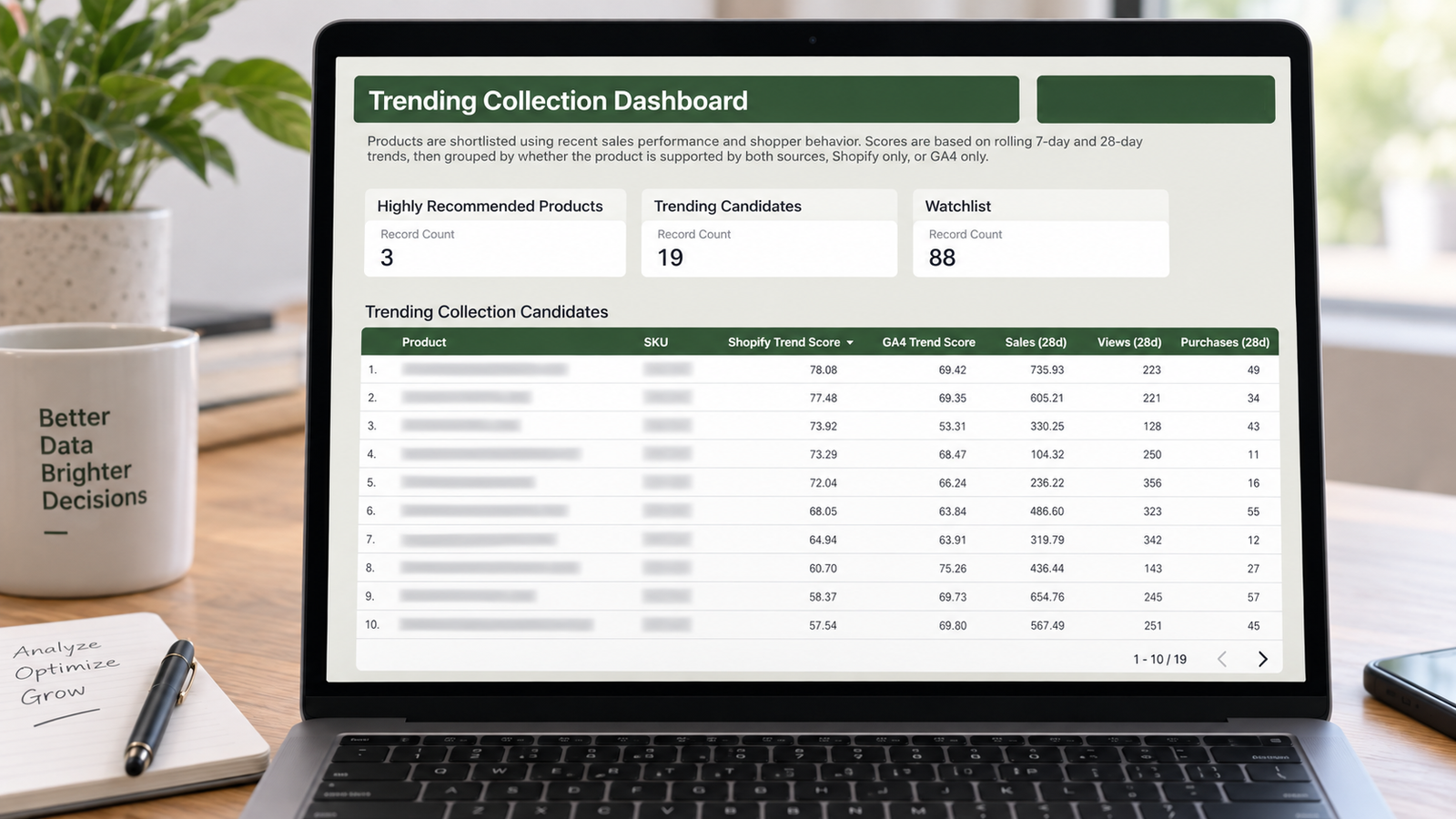
Project Overview
Identifying which products were genuinely gaining momentum was difficult when looking at sales performance or website behavior in isolation. Strong recent sales could reflect established demand, while rising product views or add-to-cart activity could signal emerging interest before it translated into meaningful revenue.
I built a weighted product scoring model that evaluates Shopify performance and GA4 behavioral signals separately, then compares the results to create a more useful view of product momentum. The existing recommendation setup leaned heavily on native store and purchase signals, so I wanted to complement it with additional behavioral features from GA4 such as product interest, add-to-cart activity and changes in purchase behavior. This created a broader signal set for identifying emerging products and supporting merchandising and recommendation decisions.
The idea was not to replace the app’s recommendation engine, but to create an additional data layer that could make merchandising decisions—and potentially the product sets supplied to recommendation widgets—more informed.
The Challenge
Product popularity is easy to misread when viewed through a single data source. A product can have strong sales because it is already well established, while another may be gaining interest through product views and add-to-cart activity before that demand is fully reflected in revenue. Relying too heavily on historical sales can therefore introduce a form of selection bias toward already-proven products, making emerging demand easier to overlook.
The existing recommendation setup already had access to native ecommerce signals, but I wanted a separate framework that could evaluate commercial performance and behavioral momentum together. The challenge was deciding which signals mattered, how much weight each should receive, and how to prevent low-volume products from appearing artificially strong because of short-term percentage spikes.
The model therefore needed to balance growth, scale and quality of demand while remaining simple enough to explain, review and adjust as merchandising priorities changed.
The Approach
I structured the reporting around a simple diagnostic flow: establish reliable source metrics, compare performance consistently, then trace changes through the underlying drivers before turning them into clear priorities.
01
Separate commercial and behavioral signals
I created two scoring frameworks rather than forcing Shopify and GA4 data into a single score. Shopify measured commercial performance, while GA4 captured behavioral momentum such as product interest, add-to-cart activity and purchase behavior.
02
Define meaningful features and weights
Each model weighted the signals according to what they contributed to the decision. The Shopify score placed greater emphasis on recent sales growth while still accounting for longer-term growth, units sold, net sales and margin. The GA4 score balanced short- and longer-term growth in product views, add-to-cart activity and purchases with 28-day revenue, add-to-cart rate and purchase rate.
Shopify Commercial Score
Fast evaluation mode
| Feature | Weight |
| 7-day Sales Growth | 40% |
| 28-day Sales Growth | 20% |
| 28-day Margin | 20% |
| 28-day Units Sold | 10% |
| 28-day Net Sales | 10% |
GA4 Behavioral Score
Fast evaluation mode
| Feature | Weight |
| 28-day Views Growth | 15% |
| 28-day Add-to-Cart Growth | 15% |
| 28-day Purchase Growth | 15% |
| 28-day Revenue | 10% |
| 28-day Add-to-Cart Rate | 10% |
| 28-day Purchase Rate | 10% |
| 7-day Views Growth | 10% |
| 7-day Add-to-Cart Growth | 10% |
| 7-day Purchase Growth | 5% |
03
Add minimum thresholds
Growth percentages can become misleading when the underlying volume is very small. I introduced minimum activity requirements before a product could qualify for a recommendation. For Shopify, products needed at least 5 units sold, $25 in net sales and a 5% margin over 28 days. For GA4, products needed at least 100 views, 10 purchases and $10 in revenue over 28 days. Growth measures were also capped before scaling to reduce the influence of extreme outliers.
04
Classify and compare the outputs
Products that passed the minimum filters were classified as Recommend, Watch or Low Priority based on their trend score, using thresholds of 70 and 45 to separate the tiers. I then compared the Shopify and GA4 outputs to identify products showing strength across both commercial performance and behavioural demand, while also monitoring products gaining traction in only one source.
05
Turn the scores into a merchandising input
The resulting shortlist was designed to support decisions around homepage merchandising, product discovery and recommendation testing. Rather than replacing the existing recommendation engine, the model created an additional data layer that could inform which products were worth promoting or testing more aggressively.
What I Built
I built two separate scoring pipelines—one focused on Shopify commercial performance and another on GA4 behavioral momentum. Each model standardized its underlying features, applied the selected weights and minimum thresholds, then ranked products based on their resulting trend score.
The outputs were designed to be useful beyond the score itself. Products were classified into recommendation tiers and the Shopify and GA4 results could then be compared to identify where commercial performance and customer behavior were reinforcing each other—or where one source was signaling momentum that the other had not yet captured.
Product Trend Scoring Dashboard
Product Trend Scoring Dashboard
I brought the Shopify and GA4 scoring outputs into a single dashboard so the resulting product tiers, cross-source signals and ranked candidates could be reviewed in one place.
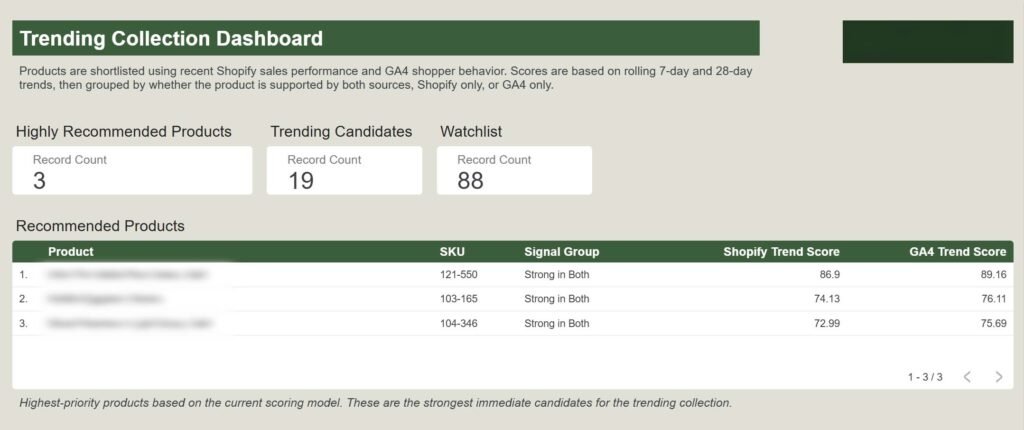
Comparing Commercial and Behavioural Momentum
The dashboard keeps Shopify and GA4 scores visible side by side so products can be evaluated across both commercial performance and behavioral demand. Products showing strength in both sources provide the strongest immediate candidates, while single-source signals can highlight items that may deserve further monitoring or testing.
From Scores to Decisions
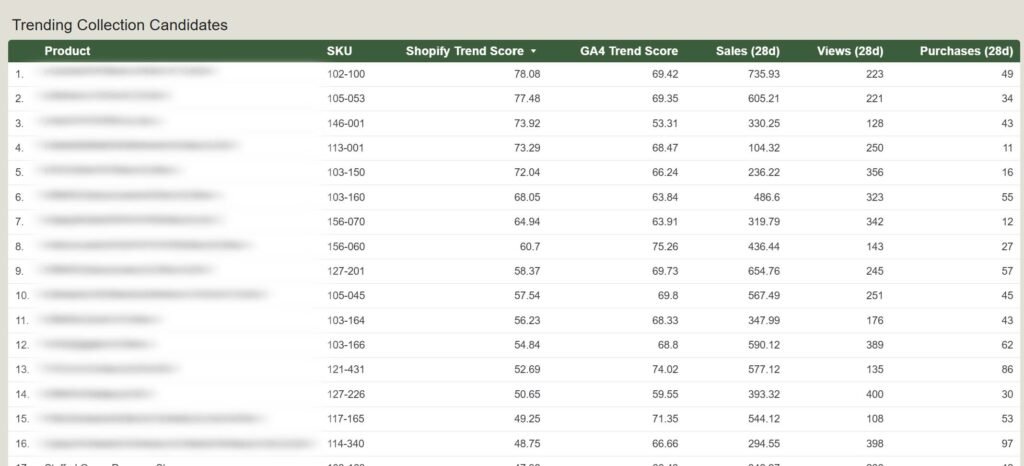
The scoring model was designed to support action, not just ranking. By comparing Shopify commercial performance with GA4 behavioral momentum, the shortlist could be used to decide which products were worth promoting, monitoring or testing more aggressively.
Example: Identifying Emerging Opportunities
A product performing strongly in both Shopify and GA4 provides a higher-confidence signal that commercial demand and shopper interest are moving in the same direction. Products showing strength in only one source can still be useful: Shopify-only momentum may reflect proven sales performance, while GA4-only momentum can surface growing customer interest before it fully translates into sales.
The Outcome
The result was a repeatable product-prioritization framework that moved trending-product selection beyond best-seller lists and individual data sources. Instead of relying only on historical commercial performance, the model introduced behavioral signals that could surface products gaining customer interest before that momentum was fully reflected in sales.
Keeping the Shopify and GA4 models separate also preserved the context behind each signal. Products supported by both sources could be treated as higher-confidence candidates, while differences between the two scores created useful areas for further review rather than being hidden inside a single blended score.
The framework created a practical shortlist for merchandising, homepage placement and recommendation testing, while remaining flexible enough for the weights, thresholds and evaluation windows to be reviewed as more performance data became available.
- Reduced reliance on a single source of product performance, helping counter the bias toward already-established best sellers
- Created a repeatable way to identify emerging product momentum using both commercial and behavioral signals
- Turned hundreds of products into prioritized tiers, making merchandising review more focused
- Created an additional input for recommendation and CRO testing, rather than replacing the existing recommendation engine
- Established an iterative scoring framework whose features, weights and thresholds can be refined based on future test results