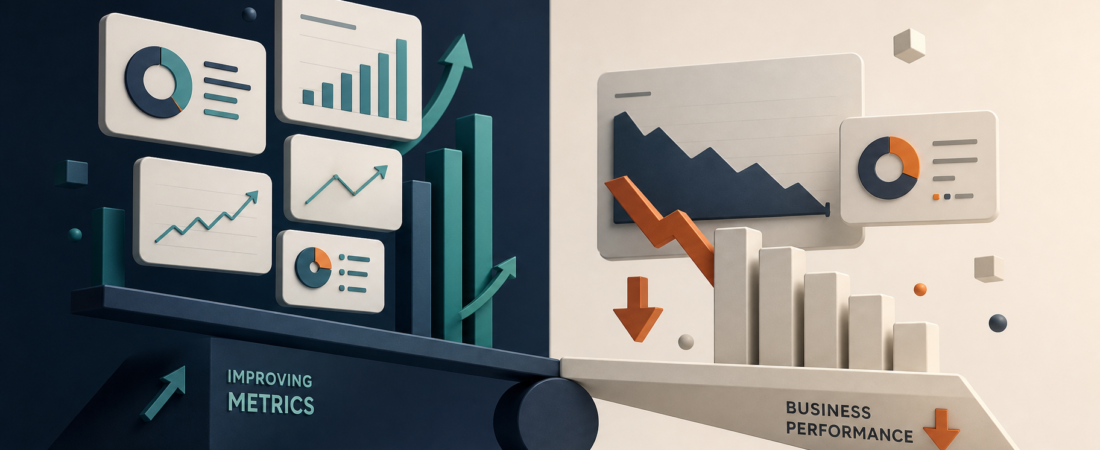
An increase in conversion rate, higher AOV, stronger revenue, or a reduction in customer acquisition costs would generally be good news in a business performance report. These are among the indicators companies regularly monitor to understand whether their operations and strategies are producing results.
It’s also natural to associate improving metrics with improving performance. After all, businesses establish KPIs precisely because they want measurable ways to evaluate progress, identify problems, and hold teams accountable.
But through my experience working with performance reports and business analytics, I’ve become more interested in what happens around those numbers. A metric can move in the right direction while other indicators suggest a different story. Sometimes, the improvement is genuine but comes with trade-offs. Other times, it may partly reflect changes in the underlying conditions rather than improvements in the business itself.
This doesn’t make the metric unreliable or unimportant. It means that understanding the improvement requires looking beyond the number itself, including what contributed to it and what may have changed elsewhere in the business.
When a Higher Conversion Rate Doesn’t Tell the Whole Story
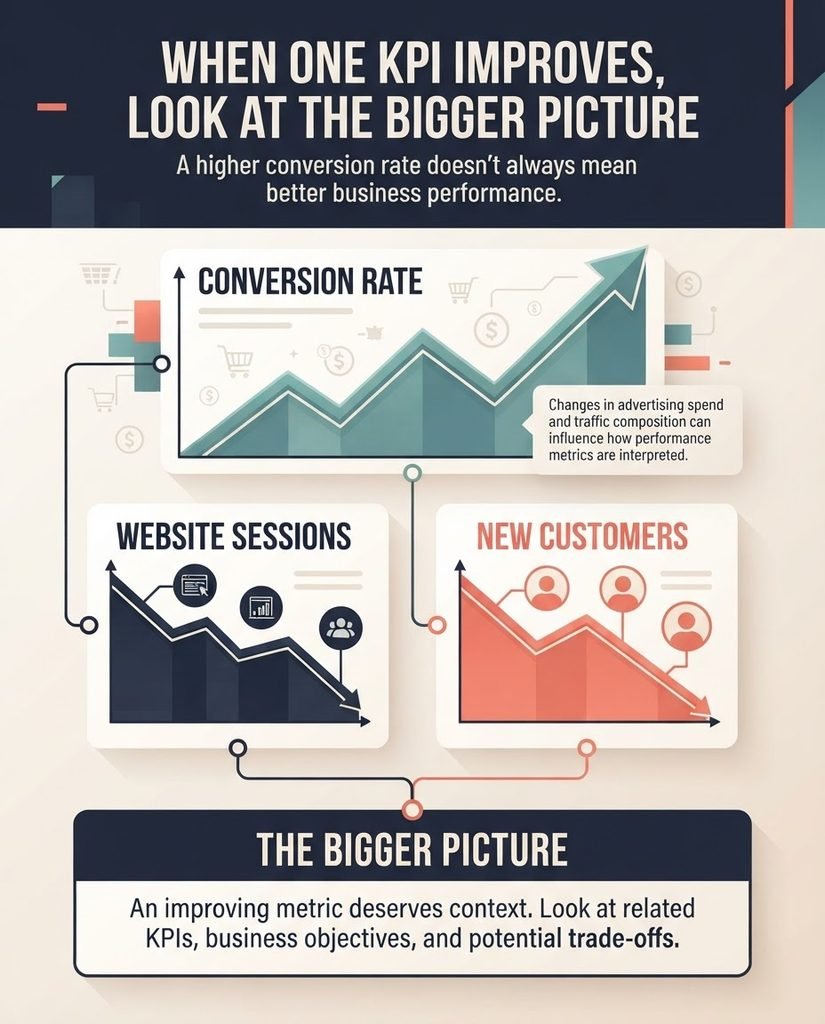
Consider an ecommerce business that reduces its advertising budget to focus on other operational priorities. Over the following weeks, website sessions decline, but its conversion rate begins to increase.
When you look at it at first, the conversion rate improvement looks encouraging. A higher proportion of visitors are completing purchases which is generally something ecommerce businesses want to achieve (your manager would definitely be happy!)
However, the decline in sessions changes how we might interpret that improvement.
Reducing advertising activity can affect not only the number of visitors reaching a website but also the composition of that traffic. If fewer visitors with relatively low purchase intent are entering the site, the overall conversion rate could increase even without meaningful changes to the shopping experience.
It is also possible for conversion rate to increase while the total number of orders decreases. A higher percentage of a smaller audience does not necessarily translate into more purchases or more revenue.
In this situation, the improvement becomes more interesting when considered alongside other indicators. Sessions have declined, new customer acquisition may have slowed, and the company is spending less on advertising. Each movement contributes to a more complete understanding of what is happening.
That doesn’t mean reducing the advertising budget was the wrong decision. The company may have had valid reasons for temporarily prioritizing efficiency, profitability, or improvements elsewhere in the business. Whether the outcome represents progress depends partly on what the company was trying to accomplish.
When evaluating changes like these, I find it useful to examine related metrics and recent business activities before drawing conclusions. Even then, the patterns may only suggest possible explanations rather than establish definitive causes.
The objective isn’t to discount a positive result. It’s to understand what the improvement actually represents.
When Revenue and Average Order Value Move in Different Directions
A similar situation can occur when businesses evaluate revenue and average order value.
Revenue might increase while average order value decreases. In another period, average order value might increase even as total revenue declines. Looking at either metric independently could lead to very different interpretations of business performance.
Suppose an ecommerce business experiences revenue growth alongside a decline in average order value. Further investigation reveals that order volume increased and a substantial portion of those purchases came from new customers.
The lower average order value may initially seem concerning, particularly if increasing basket size is one of the company’s objectives. But a growing number of first-time customers could also represent an opportunity to develop longer-term customer relationships.
Whether that represents a favorable outcome depends on several other factors. Acquiring new customers has a cost, and generating additional orders does not automatically translate into greater profitability. Discounts, fulfillment expenses, product margins, and the potential for repeat purchases can all influence the business value of those sales.
The opposite situation deserves similar scrutiny. A business might successfully increase average order value through product bundles, pricing changes, or promotional offers while generating fewer orders and less overall revenue.
Neither scenario automatically represents success or failure. What matters is understanding how the metrics relate to one another and whether their combined movement supports the company’s broader objectives.
This is where I think performance analysis becomes more useful. Instead of simply reporting that one metric increased while another declined, we can begin examining the relationships between them and identifying which changes deserve further attention.
When Improving the KPI Becomes the Primary Objective
There is another consideration that goes beyond interpreting performance reports.
Businesses establish KPIs to provide direction and accountability. Departments have targets, teams are evaluated against specific results, and in some organizations, performance incentives or bonuses are connected to achieving those objectives.
There are legitimate reasons for doing this. Clear targets help organizations communicate expectations, monitor progress, and evaluate whether their strategies are producing results.
However, problems can arise when improving the metric becomes more important than understanding the broader impact of achieving it.
Consider a sales team whose primary objective is increasing revenue. Offering larger discounts might help generate more orders and achieve the target, but the resulting improvement may become less attractive once product margins and promotional costs are considered.
Similarly, an operations team might be asked to improve productivity or reduce costs. The department could achieve its targets while increasing employee workloads, compromising service quality, or creating operational problems that become apparent only later.
These examples illustrate a broader concern. A metric can improve while other important aspects of the business deteriorate, particularly when those consequences fall outside the measurements used to evaluate success.
This doesn’t mean that performance targets are inherently harmful or that businesses should stop using them. It means that the way targets are defined, pursued, and evaluated deserves as much attention as the results themselves.
An organization can become very effective at improving what it measures while overlooking outcomes that are harder to quantify, including employee well-being, customer trust, and long-term business resilience.
The challenge is not simply to achieve better numbers, but to understand what the business may be gaining or sacrificing in the process.
Looking Beyond the Target
One reason evaluating performance can be difficult is that businesses rarely pursue only one objective.
A company may want to increase revenue while protecting profitability, acquire more customers while controlling marketing costs, or improve operational efficiency without compromising quality.
These objectives can complement one another, but they can also involve trade-offs.
For example, a business prioritizing customer acquisition might be willing to accept a temporarily higher acquisition cost if it has reasonable evidence that those customers will generate sufficient long-term value. Another business facing financial constraints might prioritize cash flow and profitability, even if doing so means accepting slower growth.
The same KPI movement can therefore have different implications depending on the company’s circumstances and priorities.
But even when a target aligns with the organization’s strategy, that doesn’t mean its wider consequences should be ignored.
If a company successfully reduces operating expenses, it is still worth examining whether service quality, employee workloads, or customer satisfaction have been affected. If revenue increases, it is worth understanding the contribution of order volume, pricing, and margins rather than assuming the increase automatically represents stronger financial performance.
These considerations become especially important when teams are evaluated primarily on metrics within their own areas of responsibility. An improvement that benefits one department’s scorecard may not always translate into an equivalent benefit for the business as a whole.
This is why I believe performance targets should be reviewed alongside related indicators and broader business objectives, rather than treated as isolated measures of success.
The goal isn’t to make every performance review unnecessarily complicated. It’s to recognize that individual metrics represent parts of a larger business system, and improving one part can influence others in ways that deserve attention.
From Reporting Numbers to Understanding Business Progress
I’ve found that some of the more useful conversations around performance reporting begin when we look beyond the primary KPIs.
An improving metric might prompt questions about changes in traffic, customer behavior, pricing, or marketing activity. A declining metric might lead to a discussion about whether the movement was expected, temporary, or indicative of a larger problem.
Not every change requires an extensive investigation. Sometimes, comparing a few related indicators and reviewing recent business activities provides enough context to identify a reasonable explanation. Other situations require deeper analysis before meaningful conclusions can be reached.
And not every report needs to end with a recommendation.
Sometimes the value lies in presenting the available evidence clearly, identifying possible explanations, and helping the people involved develop a more complete understanding of what is happening. Discussions around the data can also introduce operational or strategic context that isn’t immediately visible in the numbers.
This is one of the reasons I believe good performance reporting should support conversations rather than simply provide a scorecard. It should help people understand not only whether targets were achieved, but also what contributed to those results and how they relate to the organization’s broader priorities.
KPIs remain essential tools for managing performance. Without them, businesses would have a much harder time evaluating progress or identifying where improvements are needed. But they are still measurements of particular aspects of the business, not complete representations of its overall health.
An improving metric deserves recognition, but it also deserves context. The conditions that produced the improvement, its effects on other indicators, and the potential consequences for the business all contribute to understanding whether meaningful progress has been made.
Ultimately, the question shouldn’t be limited to whether the numbers improved. It should also be whether the business is better off because of how those improvements were achieved.