
Every time I open and read the tech and business news, it seems someone has built another application, automated a workflow, or launched a new SaaS product using AI. I’ve found it interesting to see how much more accessible software development has become, particularly for people who previously had limited programming experience. Ideas that might once have required considerable technical resources can now be developed into working prototypes with the assistance of AI tools.
There is research supporting improvements in development productivity. A study involving 4,867 software developers found that those given access to AI coding assistance completed approximately 26% more tasks. While developing a prototype is still very different from maintaining reliable, secure software, the findings illustrate how AI is changing the work involved in software development.
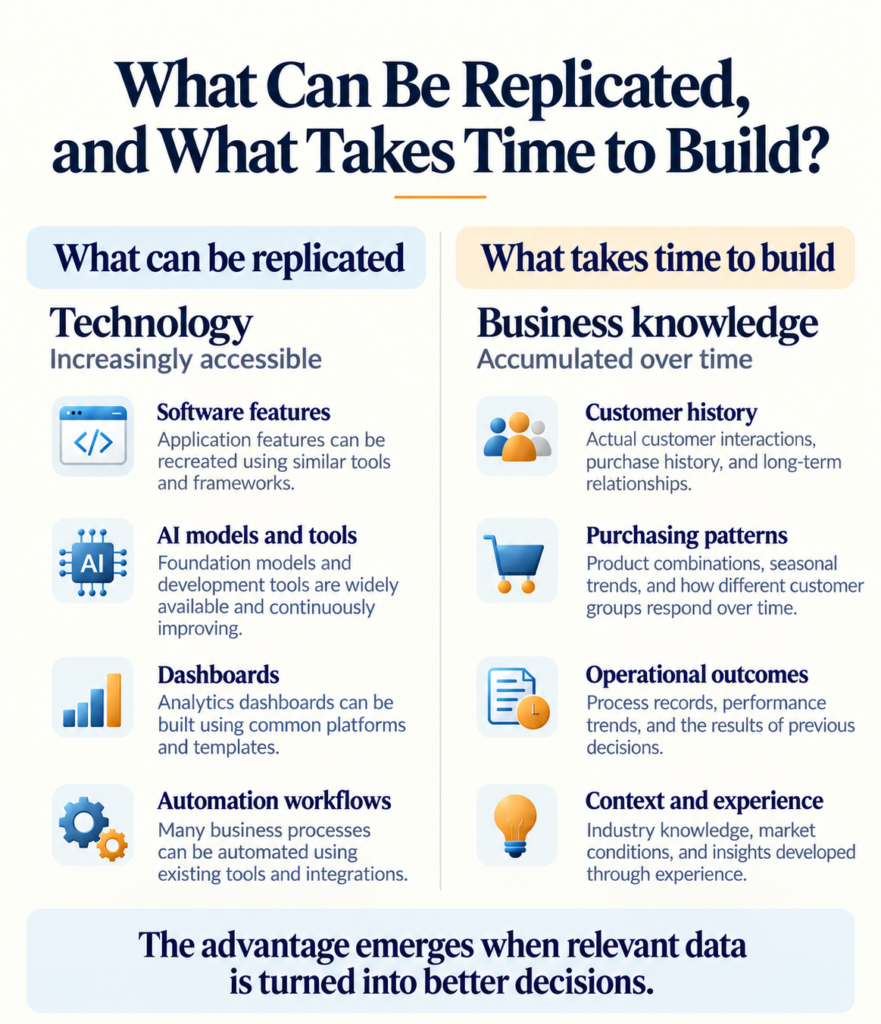
As more people gain access to similar development tools and underlying AI models, I’ve started thinking about what this means for businesses trying to maintain a competitive advantage. Features that previously required significant development effort may become easier for competitors to reproduce, even if replicating an entire business remains considerably more difficult.
This brings me to something that I think deserves more attention: the value of the information businesses have accumulated through years of operating, serving customers, and making decisions. Some of that information may represent an advantage that competitors cannot simply recreate by building similar technology.
Understanding the Data Moat
A data moat is a competitive advantage created by information that competitors cannot easily obtain, reproduce, or use in the same way. It can come from unique customer relationships, historical transactions, operational records, or knowledge developed through years of business activity.
Consider two ecommerce retailers selling similar products. Both might use the same ecommerce platform, advertising channels, analytics tools, and recommendation algorithms. From a technical perspective, their capabilities could look almost identical, but one retailer has been operating for ten years while the other opened only recently.
Over those ten years, the established retailer may have accumulated customer purchase histories, seasonal purchasing patterns, promotional outcomes, product relationships, and operational records. It could potentially understand which products customers purchase together, how purchasing behavior changes throughout the year, and how different customer groups respond to pricing or promotions.
The newer competitor could build similar analytical systems and might even develop more sophisticated models. However, it cannot immediately reproduce the established retailer’s history with its particular customers. Data from another retailer may provide useful general insights, but it won’t necessarily capture the same customer relationships, preferences, or purchasing circumstances.
This distinction is important because information that’s valuable to one business isn’t automatically equally valuable to another. Even companies operating in the same industry can have different customers, product assortments, pricing strategies, and operational challenges.
In a Harvard Business Review article on proprietary data strategy, Thomas Davenport and Thomas Redman discuss how information unique to an organization, or developed into a distinctive business asset, can become a source of competitive advantage. The value comes partly from how difficult that information is for others to reproduce.
However, having historical information doesn’t automatically mean a company has a strong data moat. The data must still be relevant, reliable, and capable of supporting something valuable that competitors cannot easily replicate.
The Value of Data That Has Been Sitting There All Along
Businesses accumulate information through their everyday operations, often without considering how it might eventually be used. Customer transactions, inventory, marketing performance, operational logs, and historical business outcomes may originally be recorded for simple purposes such as processing orders, preparing financial reports, or monitoring daily activity.
Over time, however, the usefulness of that information can change. An ecommerce business might initially use its transaction history to calculate monthly revenue and AOV. Several years later, it might want to understand which customers are likely to purchase again, identify products frequently purchased together, or investigate how promotional activity influences long-term customer behavior.
Information that once supported basic reporting may become useful for analytical questions that weren’t even being considered when it was first collected. This is one reason I find approaches such as ELT valuable. When implemented appropriately, ELT allows organizations to load source information into a suitable storage environment and apply transformations according to their analytical needs, including questions that would emerge later.
This doesn’t mean businesses should collect and retain everything indefinitely. Privacy obligations, security, storage costs, data quality, and appropriate retention policies all need to be considered. Rather, the idea is to recognize that information without an immediate analytical purpose may still have future value provided there is a legitimate reason to preserve it.
There is also an important distinction between possessing data and generating business value from it. Imagine an established retailer with ten years of transaction history but limited analytical capabilities. Its information is scattered across different systems, most reports are prepared manually, and historical patterns rarely influence decisions.
Now imagine a younger competitor with only two years of records but an established practice of analyzing customer behavior, testing improvements, and using those findings to guide its operations. The younger business may be generating more value from its data today, even though it has accumulated far less information.
That doesn’t necessarily eliminate the established retailer’s potential advantage. If it develops the capabilities needed to organize and analyze its historical information, it may uncover patterns that the younger business lacks sufficient history to investigate. Of course, this depends on whether those records are complete, relevant, and reflective of current business conditions.
In another Harvard Business Review analysis, Andrei Hagiu and Julian Wright explain why businesses often overestimate the competitive benefits of accumulating customer data. More information doesn’t always produce proportionately better insights, and competitors may be able to obtain similar benefits using smaller datasets.
I think this is an important qualification. Historical data can be a valuable asset but its competitive significance depends on what the business can actually learn from it and how those insights influence its performance.
AI Can Analyze Data, but Understanding the Results Still Matters
With AI becoming more accessible, businesses have new ways to work with information without necessarily developing every analytical capability from scratch. A business owner can upload a dataset, ask questions, generate visualizations, or request a forecast without having to write all the underlying code.
For smaller businesses that might not have dedicated analytics teams, this is a meaningful development. However, easier access to analytical tools doesn’t necessarily make the resulting analysis reliable or useful. The quality of the questions, the suitability of the methods, and the interpretation of the findings still matter.
Suppose a business owner asks AI to forecast sales for the next two months. It might return a reasonable-looking projection with supporting charts and explanations, but several factors could affect whether the results are dependable. Historical sales might have been influenced by seasonal demand, unusually aggressive promotions, inventory shortages, or changes in advertising expenditure. The forecasting method itself might also be unsuitable for the available data, particularly if it hasn’t been evaluated against previous periods.
Someone with statistical and programming expertise might recognize weaknesses in the model or understand how to test its reliability. Meanwhile, someone familiar with the business might identify circumstances that aren’t immediately visible in the dataset. A technically sound model can still be misunderstood when the person interpreting it lacks the relevant business context.
I see analytical expertise and domain knowledge as complementary rather than interchangeable. A data scientist may understand how to develop predictive models but need additional context to interpret findings in a particular industry. Similarly, an experienced marketing professional might recognize an important commercial problem but require analytical expertise to investigate it properly.
AI can assist with these activities but relying entirely on its output without appropriate validation introduces its own risks. Even when a prediction is reasonably accurate, deciding how to respond to it involves business priorities, constraints, uncertainty, and judgment that extend beyond the model itself.
Just Because We Can Build It Doesn’t Mean We Should
Another consequence of increasingly accessible technology is the temptation to develop something simply because doing so has become possible. As new AI applications, automation tools, and SaaS products emerge, businesses may begin exploring similar capabilities without first establishing whether they address an important problem.
During my master’s studies, we discussed an opportunity matrix that evaluates potential initiatives according to their business impact and feasibility. I think it’s a useful framework for examining technology investments because it separates what an organisation is technically capable of doing from what would actually be worth pursuing.
Business impact considers the potential benefits of an initiative, such as revenue growth, cost reduction, improved customer experience, or operational efficiency. Feasibility considers the data, infrastructure, expertise, resources, and organisational readiness required to implement it successfully.
For example, a company might have enough historical information to build a predictive model but that doesn’t necessarily establish a compelling reason to develop one. A simpler analysis might answer the underlying business question, or an improvement to an existing process might generate greater value at a lower cost.
This distinction is also reflected in broader research on AI adoption. In its 2025 State of AI survey, McKinsey found that while AI use was widespread, only 39% of respondents reported an impact on enterprise-level earnings before interest and taxes attributable to AI. That doesn’t mean other organizations received no benefits, but it does illustrate the gap between adopting a technology and demonstrating measurable financial impact across a business.
As development becomes easier, evaluating opportunities carefully may become even more important. The fact that a company can create a particular application or adopt an AI tool doesn’t automatically mean doing so should be a strategic priority.
Start With the Problem, Then Examine What You Already Know
I don’t think there’s a universal starting point for businesses looking to generate more value from their historical information. It depends on their goals, the challenges they’re facing, and the decisions they need to make.
Consider an ecommerce retailer that’s performing well in terms of revenue but wants to increase average order value. The business might have a substantial customer base while recognising that some customers could be purchasing more or discovering additional products that are relevant to them.
Instead of immediately implementing a sophisticated recommendation engine, it could begin by examining existing transaction data. Historical purchases might reveal products that frequently appear together, spending patterns across customer groups, or opportunities to improve how products are presented. These findings could inform changes that the business can test before committing to more complex technology.
Another company might be performing well financially but have inefficient internal approval processes. In that situation, historical customer transactions may have little relevance to the immediate problem. Operational records could provide more useful information about processing times, recurring bottlenecks, or unnecessary steps that delay decisions.
Both organizations are using accumulated data to investigate opportunities, but their objectives, information requirements, and appropriate methods are different. The value isn’t determined by how advanced the analysis looks but by whether it helps address the problem the business is trying to solve.
This is also why I think businesses should approach data moats as part of a broader strategy rather than treating them as another initiative that needs to be pursued. Preserving valuable information matters, but understanding which business problems deserve attention helps determine how that information should be used.
An Advantage Worth Understanding
I don’t think AI has suddenly made proprietary business data valuable. Businesses have relied on historical information to understand customers, manage operations, and guide decisions for decades. What AI is changing is the accessibility of some of the tools used to develop software and analyze that information, potentially allowing more businesses to explore opportunities that previously required greater technical resources.
At the same time, I wonder how many organizations are paying more attention to the applications being developed around them than to the information they’ve already accumulated. A competitor might recreate a dashboard, build similar software, or use the same analytical model, but it cannot instantly reproduce years of customer relationships, transaction history, and the context behind a business’s previous decisions.
That doesn’t make a data moat permanent or guarantee that an established business will outperform a newer competitor. Historical information can become outdated, competitors can accumulate their own valuable data, and having access to unique records doesn’t automatically translate into better decisions.
Still, I think there’s an opportunity for businesses to look more carefully at the information they already possess. Not necessarily to develop another AI application or build more sophisticated models, but to understand what that history might reveal about their customers, operations, and opportunities for improvement.
As technology becomes more accessible, the distinction between being able to build something and knowing what is worth building becomes increasingly relevant. And for some businesses, the knowledge needed to make that distinction may already exist in the data they’ve accumulated over the years.
Sources & Further Reading
Cui, Z. K., Demirer, M., Jaffe, S., Musolff, L., Peng, S., & Salz, T. (2025). The effects of generative AI on high-skilled work: Evidence from three field experiments with software developers. Microsoft Research.
Davenport, T. H., & Redman, T. C. (2020, May 4). Your organization needs a proprietary data strategy. Harvard Business Review.
Hagiu, A., & Wright, J. (2020, January–February). When data creates competitive advantage. Harvard Business Review.
McKinsey & Company. (2025, November 5). The state of AI in 2025: Agents, innovation, and transformation. McKinsey & Company.