Lately, I’ve been noticing how much of the conversation around AI has shifted toward automation. Almost every week, there’s a new tool, feature, or capability promising to make something faster, easier, or completely autonomous.
On LinkedIn, I’ve come across marketers experimenting with AI systems that can manage advertising campaigns, optimize budgets, and make decisions with minimal human involvement. Some of these experiments are genuinely interesting and I can understand the excitement. After all, who wouldn’t want to spend less time on repetitive tasks and more time on work that actually matters?
But seeing how quickly everyone seems to be racing toward automation has made me think about something we recently discussed in one of my master’s courses.
As prediction becomes cheaper, human judgment becomes more valuable.
It’s an idea that has stayed with me, especially as AI continues to advance and businesses look for more ways to automate not only their processes but also their decisions.
What concerns me isn’t necessarily how capable AI is becoming. It’s how easily we seem to accept that if something can be automated, then automating it must be the next logical step.
When Efficiency Becomes the Goal
From a business perspective, the appeal of automation is understandable. Companies want to reduce costs, improve productivity, increase profitability, and remain competitive (I mean who doesn’t??). AI offers opportunities to achieve those objectives, sometimes at a speed and scale that weren’t previously possible.
Take digital advertising as an example. An AI system might analyze campaign performance, predict which audiences are more likely to convert, and automatically allocate budgets toward the campaigns producing the best results.
If the system improves return on ad spend while reducing the time someone spends managing campaigns, it’s easy to consider that a success.
But I think there’s a difference between optimizing a process and understanding the broader decision behind it.
A campaign might be generating better short-term returns while doing little to attract new customers. The system could be concentrating spending on customers who were already likely to purchase, while overlooking longer-term opportunities to grow the business.
The AI may be doing exactly what it was designed to do. The problem could be that we’re measuring success too narrowly.
This isn’t limited to marketing. The same question applies when businesses use AI to automate customer service, operations, recruitment, financial decisions, and other functions.
We’re becoming increasingly capable of identifying the most efficient way to do something. Now the question becomes – are we spending enough time deciding what we should actually be optimizing for?
What Happens When Everyone Follows the Same Strategy?
This is where I think the conversation becomes more complicated.
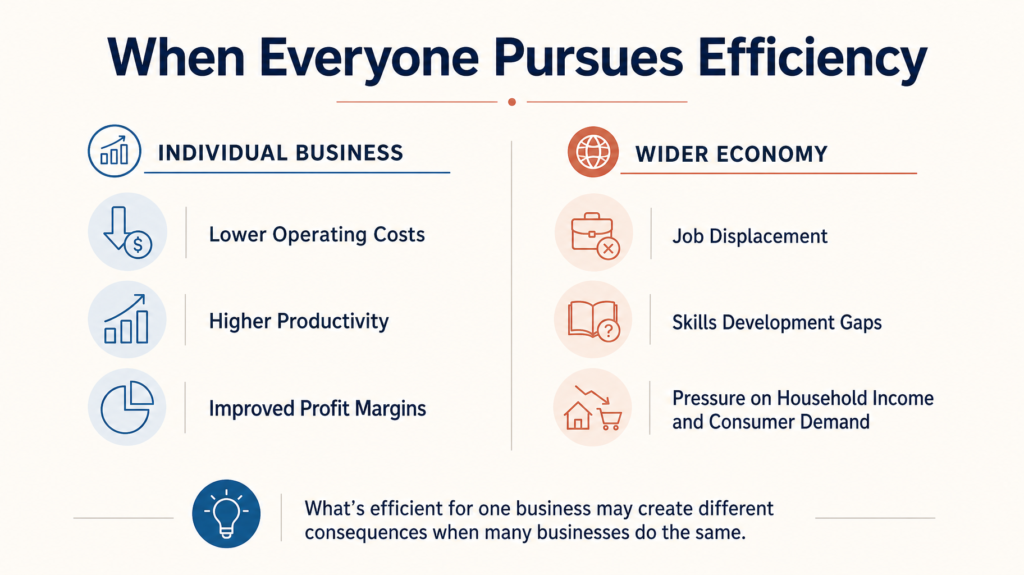
For an individual business, automating certain functions can be a reasonable decision. If technology allows a company to perform the same work at a lower cost, it can improve profitability and free up resources for other priorities.
But consider what happens when thousands of businesses start making similar decisions.
If companies increasingly use AI to reduce their dependence on human labor, what happens to the employees whose work is displaced? What happens to household income and consumer spending if new employment opportunities don’t emerge quickly enough?
Businesses ultimately depend on customers who have the purchasing power to buy their products and services. So while reducing labor costs might benefit an individual company, widespread displacement could create economic challenges that eventually affect those same businesses.
Of course, this isn’t a guaranteed outcome. Technology has historically created new jobs and industries while transforming or eliminating others. AI could also make products and services more affordable, create new opportunities, and contribute to economic growth.
The question is how that transition happens, how quickly people can adapt, and how the benefits are distributed.
According to the International Monetary Fund, almost 40% of global employment is exposed to AI, with some jobs likely to benefit from improved productivity while others face potential disruption.
The International Labour Organization also reported in 2025 that one in four jobs worldwide has some exposure to generative AI, although transforming existing jobs is considered more likely than replacing them entirely.
These findings don’t necessarily suggest that widespread unemployment is inevitable. But they do suggest that the economic implications deserve as much attention as the productivity gains we’re celebrating.
The Problem With the Race to Automate
I also wonder how much of this is driven by competition rather than careful consideration of what businesses actually need.
Companies developing AI products are competing for users, investment, and market share. Businesses adopting those products are competing to operate more efficiently than their rivals.
Even when decision-makers understand the potential consequences of automation, they may feel they have little choice but to keep up.
If one company can significantly lower its operating costs through AI, competitors may feel pressured to follow. Choosing not to automate could eventually put them at a disadvantage.
This creates an interesting economic problem. What’s beneficial for an individual business in the short term may not necessarily produce the best outcome when everyone pursues the same strategy.
And I don’t think we can solve that simply by asking businesses to be more responsible. Competition creates real incentives, and expecting every organization to voluntarily prioritize long-term social outcomes over its immediate survival or profitability may be unrealistic.
That’s partly why conversations about AI shouldn’t be limited to what the technology can accomplish. They should also include how businesses, workers, institutions, and policymakers respond to the changes it creates.
The other day, I was reading some comments on a post about AI and one comment stood out to me. If AI eventually takes over most entry-level and repetitive tasks, the kind of work we often find tedious, how will someone who is just entering the workforce learn the ropes? Making mistakes, figuring things out, and learning from experience are often how we develop a deeper understanding of our work and build resilience. If those opportunities become increasingly automated, where will the next generation of experienced professionals come from? Does that mean future entry-level jobs will involve managing AI agents, even before someone has gained the practical experience needed to understand what those agents are doing?
Prediction Is Not the Same as Judgment
In Prediction Machines, Ajay Agrawal, Joshua Gans, and Avi Goldfarb explain AI through an economic perspective: improvements in prediction technology reduce the cost of prediction, changing how decisions can be made.
One of the ideas I find particularly interesting is the distinction between prediction and judgment.
Prediction helps us estimate what might happen. Judgment helps determine how much different outcomes matter and what actions are worth taking.
For example, AI might predict that reducing customer service staffing and introducing an automated support system would lower operating costs.
But deciding whether the savings justify possible changes in customer experience, employee livelihoods, and long-term brand relationships requires more than a prediction.
A system can optimize for the objectives we give it. That doesn’t automatically mean we’ve chosen the right objectives.
And as prediction becomes increasingly accessible, I think this is where human judgment becomes especially important.
Not because humans are always better at making decisions. We certainly aren’t. We have biases, limited information, and our own incentives that can lead to poor choices.
But someone still needs to question the assumptions, consider the trade-offs, and take responsibility for the consequences.
In some situations, AI may even help us make better judgments by allowing us to explore scenarios and understand risks that would otherwise be difficult to evaluate.
The opportunity, at least from how I see it, is to use that capability to improve decision-making rather than simply remove people from the process.
Rethinking What Progress Looks Like
I use AI in my own work and I can appreciate how much it has changed what individuals and small teams can accomplish. Tasks that previously required considerable time or technical resources have become more accessible and I think that’s a meaningful development.
I also don’t believe that every process needs human intervention just for the sake of keeping someone involved. There are situations where automation is practical, reliable, and clearly beneficial.
What I question is the assumption that increasing automation should always be the goal.
For businesses, better technology creates an opportunity to improve how they operate. But efficiency is only one part of business performance, and financial returns are only one way of measuring the value created by technological progress.
If we’re going to automate more of the decisions that influence how businesses operate and how people work, we should be equally interested in understanding the consequences of those decisions.
That includes questioning which outcomes we’re optimizing for, who benefits from the improvements, who bears the risks, and how we respond when the results aren’t what we expected.
I don’t think the future of AI should be measured simply by how much work we can automate or how many decisions we can make without human involvement.
Perhaps a better measure of progress is how much better our decisions become, and whether the benefits extend beyond the organizations that can afford to automate first.
Because being able to automate something doesn’t necessarily mean we should.
Sources & Further Reading
The following research and publications provide additional context on AI-driven decision-making, employment, and the wider economic implications of automation.
- Agrawal, A., Gans, J., & Goldfarb, A. (2018). Prediction, Judgment and Complexity: A Theory of Decision Making and Artificial Intelligence. National Bureau of Economic Research.
- Georgieva, K. (2024). AI Will Transform the Global Economy. Let’s Make Sure It Benefits Humanity. International Monetary Fund.
- International Labour Organization (2025). Generative AI and Jobs: A Refined Global Index of Occupational Exposure. ILO Working Paper 140.